
The King of the North's In-Tray: A Tonic for the Nation, 75 Years On
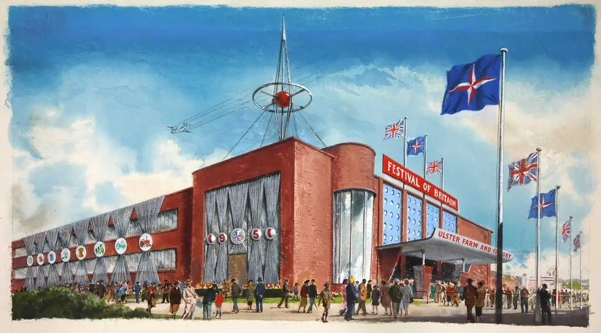
Exhibition of Industrial Power, Kelvin Hall, Glasgow (1951). Image courtesy of The National Archives.
This year marks 75 years since the Festival of Britain.
Clement Attlee’s post-war government decided that the country’s morale needed boosting. The country was still suffering the crippling effects of WW2: food and clothing were still being rationed, bombed-out town centres remained the norm, and people were living with the physical and psychological scars of the battle to defeat the Axis powers.
The economy was in a perilous position too. In 1951 the national debt was almost 180% of GDP, compared to 95% today, and inflation stood at three times what it is now at over 9%. It’s for good reason that those times were described as the ‘Age of Austerity’.
Which makes the decision to throw an expensive festival all the more surprising. Costing approximately £218 million in 2025 terms, the Labour government threw itself headfirst into a dazzling programme of events (usually involving chunky capital expenditure) throughout the year. Individual Arts Festivals across England (including in Bath, the UK's loveliest town), a folk festival and pageant in Wales, a clan gathering and poetry competition in Scotland, an industrial exhibition in Northern Ireland (see banner image). The list goes on.
Gerald Barry, the ‘eternally adolescent’ editor of the now defunct News Chronicle, who served as Festival organiser, called it a “tonic for the nation.” While redevelopment of London’s South Bank, complete with Dome of Discovery (see image 1), was undoubtedly the centrepiece, no one could argue the benefits were not distributed beyond the nation’s capital.
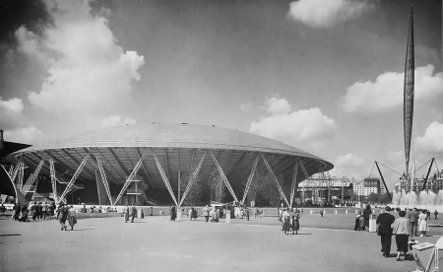
The Dome of Discovery, with the Skylon on the far right (1951). Image courtesy of The National Archives.
Of course, times have changed and direct comparisons to the post-war generation cannot easily be made. But Britain also suffers from a range of well documented economic and social dilemmas. A Labour government with a new Prime Minister waiting in the wings, will be looking for new solutions to old problems.
Andy Burnham has burnished his credentials for top office as the ‘King of the North’: the man who understands the lives of ordinary people living outside the Capital. There will be plenty in his in-tray, but he could do a lot worse than take inspiration from Attlee’s efforts to spur the nation on all those years ago.
Big events like this often have a provable positive cost-benefit ratio for the public purse. The Edinburgh Festivals return a £33 for every £1 spent by the government. Liverpool, the European Capital of Culture in 2008, claimed a 650% return on the activities that took place across the year. Following the London Olympics, the Government reported a £10 billion economic boost the year after the event (Grant Thornton, an accountancy firm, estimated benefits of four times that between 2005-2020). All these headline statistics flatter the truth a little, but the direction of travel is clear.
While the social impacts are perhaps harder to quantify, studies have also shown 2012 Games raised life satisfaction for Londoners and almost 80% of people said Liverpool was “on the rise” after the events in 2008. While more of a diffuse cultural moment, it would be hard to argue ‘Cool Britannia’, after Tony Blair’s 1997 election landslide, did not represent a moment when some people had renewed pride and optimism in the country.
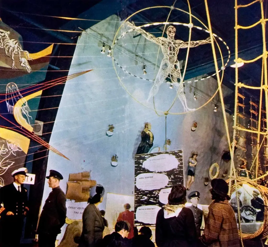
The 'Secrets of Nature' exhibition on the Campania (1951). Image courtesy of The National Archives.
Which takes me back to the King of the North’s in-tray.
As a futures and foresight professional we know the powerful ability of our work not just to help clients understand what’s next and deliver accordingly, but also motivate them to deliver their goals within their identified futures.
Much of the Festival of Britain had exactly the motivating futuristic visions I’m talking about. The Dome of Discovery included exhibits on technology and outer space, a new wing of the Science Museum opened in South Kensington, a festival ship called Campania (see Image 2) had an exciting ‘discovery’ themed exhibition that toured ports.
At a time when the future seems to be coming at a scary pace for many, and as the UK faces continued economic and social headwinds, the new administration should take inspiration from the government 75 years ago. They should mark the establishment of their new administration with a pledge for a new national festival: an exciting programme of futuristic events mirroring the bold step taken by the Attlee administration during tough times.
Six years after the festival, Harold Macmillan told Britons they had "never had it so good." Whether or not the festival deserves part of the credit, the mood had perhaps turned. A new administration that wants to be able to say the same thing one day could do worse than start where Attlee did: not with a budget line, but with a story about the future worth believing in.