
Nano Banana in Google Earth: 24 hours on X
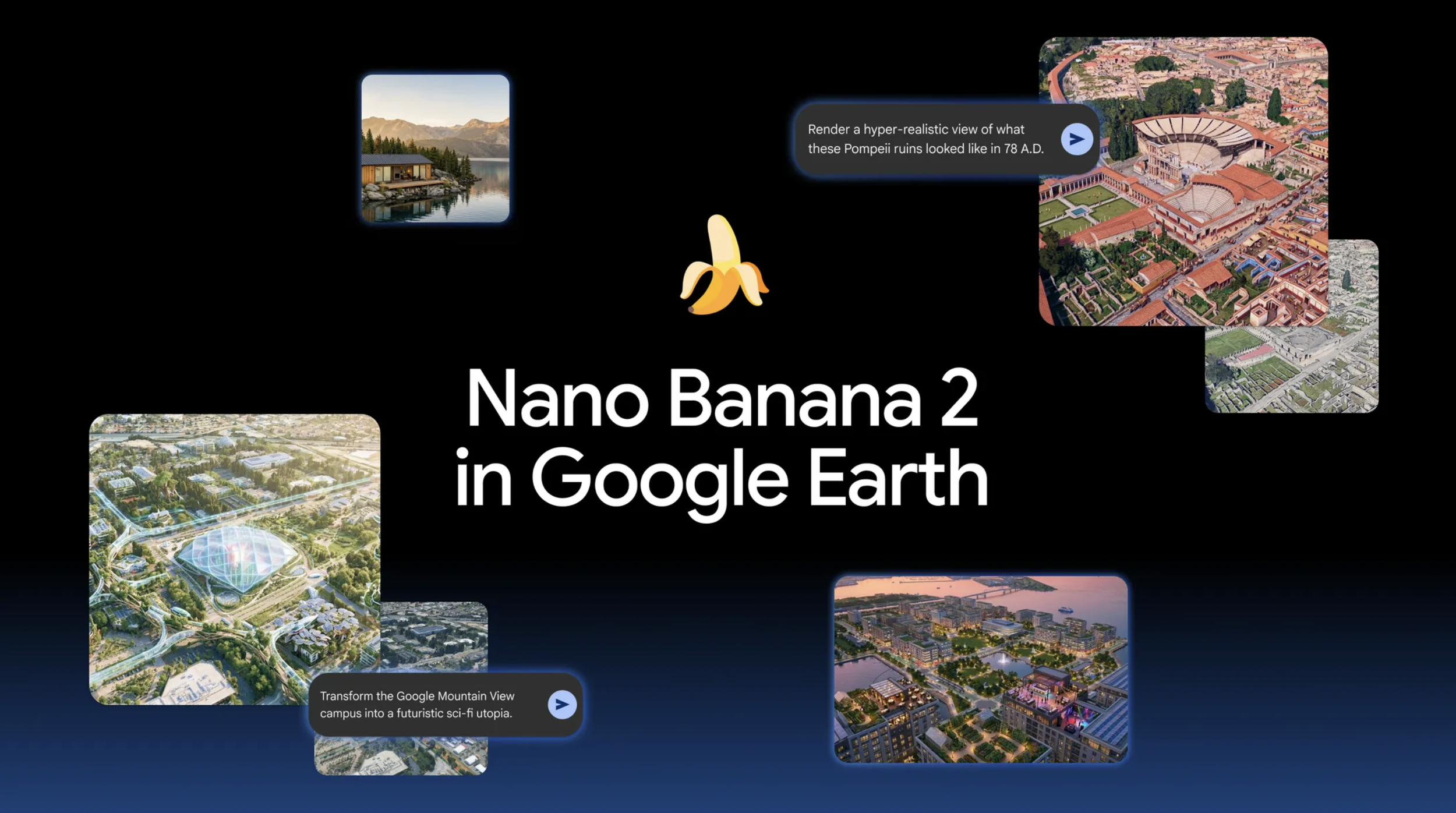
Image: Google
Approximately 24 hours. That was the gap between Google announcing that Nano Banana could be used in Google Earth, before the company issued a statement saying it was being pulled.
In that small window, you could zoom to any coordinates, type a sentence, and get a photorealistic image built on top of real satellite imagery.
What happened in the intervening period on X makes for interesting reading.
Did the platform become a dangerous quagmire of AI-generated content? Or were users mostly vigilant and aware?
One narrative about so-called Fake News is that platform users will remain alert to the possibility of AI spreading mis- and disinformation online as these tools gain prominence in our lives. That is the optimistic future.
This is a great case study of exactly that happening.
Credit largely goes to Henk van Ess.
Within hours of launch, he showed what a single sentence could produce: refugees at the Mexican border, a bomb crater beside a hospital in Gaza, a nuclear plant on Iranian soil.
Other researchers retweeted Henk’s findings. By far the most prominent liked posts were those from investigative journalist Carole Cadwalladr and Shayan Sardarizadeh from BBC Verify.
My analysis shows that, by some margin, Henk’s work gained the most traction on X during the period.
I wanted to know who used the new tool, so I searched X across its entire public life and checked where the accounts were based (factoring in X’s helpful flagging of accounts whose traffic appears to come via a VPN or proxy) and the provenance of their posts.
What I found: only 22 posts from 19 accounts across 12 geographies posted Google Earth images that received over 50 likes. 5 of these posts were not AI-generated content at all.
Of the 17 posts that remained, the United States and Switzerland led with three posts each. The Netherlands followed with two and with one post apiece for the UK, Europe, Thailand, Spain, Sri Lanka, Italy, Japan, Germany and Mexico.
Almost all of it was curiosity, jokes and research.
Analysing output on X is fraught with difficulty given the wide use of VPNs, virtual private servers, cloud desktops, roaming, foreign eSIMs, scheduling tools, API posting and even satellite services such as Starlink, to name but a few.
However, for completeness, X was also searched for Chinese, Russian and Persian language content. 45 posts matched on characters found within the Chinese term for Google Earth, but none referred to Google Earth itself. X tokenises Chinese, so the search covered ‘Google’, ‘Earth’ and ‘Google Earth’ separately. Russian and Persian searches notably returned nothing.
Another reason to be upbeat: I also ran an analysis of posts in English mentioning Google Earth – but with no image filter – during the window. 87 posts had over 50 likes and 18 over 1,000. Carole Cadwalladr’s and Shayan Sardarizadeh’s posts were the top and third most liked respectively (on 9.3k and 4k likes). Henk’s own post was second with 7.4k likes. Only 1 of the 18 contained content that could conceivably be seen to help spread mis- or disinformation.
TLDR: those 24 hours produced a handful of proof-of-concept fakes and no widespread mis- or disinformation campaign on X. The issue was raised by researchers working in public, on the platform, and fixed before it mattered.
Good job Henk.